 The
last planned activity of the alternative spring break, the trip to border
city Douglas, AZ, was one of the most anticipated by group members.
Driving down from Tucson on Good Friday, we were to take part in the
first Bi-national Stations of the Cross celebration. I was particularly
excited because this opportunity would allow us a chance to better observe
the interaction between Mexico and the United States at the border since
we would be crossing on foot as part of the program,. I was not disappointed
as in Douglas the interface was much more apparent than it had been
in Nogales, AZ (which we only had time to drive through). For me, it
was the little things, such as, the closer one got to the border the
more the signs were in Spanish, the preponderance of stores (especially
Wal-Mart) and fast food restaurants in the vicinity, and seeing people
walking towards the Mexico side with shopping bags that really gave
me more of a sense of what a border town feels like. It was also the
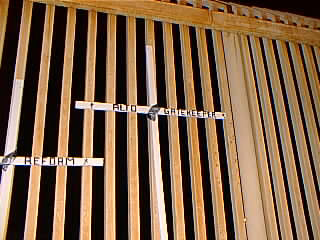
big things, like the slotted cream fence that stood 12 ft high; the
border. Joining the procession for the Bi-national Stations of the Cross
celebration at the U.S. side of the fence, I was surprised at the oppressiveness
of the structure. Never having seen the border up close before, I could
not get over the this feeling which was intensified by looking at the
fellow participants on the other side through slots in a fence meant
to keep us separated. I found it to be a very disturbing experience
and it made me wonder if that was how (more or less) people who lived
with the reality of the Berlin wall felt.
The
last planned activity of the alternative spring break, the trip to border
city Douglas, AZ, was one of the most anticipated by group members.
Driving down from Tucson on Good Friday, we were to take part in the
first Bi-national Stations of the Cross celebration. I was particularly
excited because this opportunity would allow us a chance to better observe
the interaction between Mexico and the United States at the border since
we would be crossing on foot as part of the program,. I was not disappointed
as in Douglas the interface was much more apparent than it had been
in Nogales, AZ (which we only had time to drive through). For me, it
was the little things, such as, the closer one got to the border the
more the signs were in Spanish, the preponderance of stores (especially
Wal-Mart) and fast food restaurants in the vicinity, and seeing people
walking towards the Mexico side with shopping bags that really gave
me more of a sense of what a border town feels like. It was also the
big things, like the slotted cream fence that stood 12 ft high; the
border. Joining the procession for the Bi-national Stations of the Cross
celebration at the U.S. side of the fence, I was surprised at the oppressiveness
of the structure. Never having seen the border up close before, I could
not get over the this feeling which was intensified by looking at the
fellow participants on the other side through slots in a fence meant
to keep us separated. I found it to be a very disturbing experience
and it made me wonder if that was how (more or less) people who lived
with the reality of the Berlin wall felt.
When we crossed the border and joined the rest of the procession in
Mexico, I felt as if I was in downtown Nogales, Mexico again. The brightly
colored stores, the sense of community were the same. It was neat to
see people watching animatedly the procession from wherever they happened
to be: outside a store or walking down the street. Even more amazing
was the fact that the drivers, whom in my brief experience in Mexico
were not too pedestrian friendly :-), allowed us to block the streets.
Walking up and down the street, with a picturesque sunset in the background
made the experience seem almost surreal. But it was real, and it was
confronting an issue whose ugliness very starkly contrasted the beauty
of that afternoon. This issue was the plight of the immigrant. At each
station after the biblical significance was explained, a connection
was made to the suffering of the immigrants. Then a cross was presented
related to the grim realities that immigrants often face such as one
cross that said "Arizona no Más" in response to the
immigrant deaths in the desert, or another that said "Las Mujeres"
for the women who are left in towns by themselves because their husbands
had left to find work.
The experience did not end with the end of the procession in Mexico,
as the people coming from the American side (about 15 of us) had to
cross back into the United States. Like our previous border crossing,
it was not a pleasant time. The border patrol agents let us walk through
the checkpoint station, and then stopped us right before we got to the
door, telling us we should have stopped and shown our passports. The
agent who told us this was rude and the worst part was feeling powerless
to tell him a thing or two about himself, for the rights of people at
the border, citizen or not, seems to be a very fuzzy issue. After we
had passed, another border patrol agent stopped us again and asked us
if we had been apart of a demonstration on the other side, implying
that his colleagues might have accidentally let the "troublemakers"
through the border. It was frightening and aggravating to see the amount
of paranoia and hostility that seems to reign supreme at the border.
All in all, it was a wonderful note to end the trip on. I was able to
get more of a feel for the hybrid place that I had read border towns
were, celebrate Easter a little (although the ceremony was not a religious
as I thought it might be, and show some bi-national solidarity!